
Table of Contents
Driven piles and drilled shafts can solve many of the same deep foundation problems, but they reach that goal through fundamentally different construction methods. A driven pile is a preformed structural element installed into the ground, while a drilled shaft is built by excavating a borehole and constructing a reinforced concrete element within it. That difference affects far more than installation. It changes how the foundation interacts with soil, how groundwater is managed, what happens around neighboring structures, how quality is verified, what equipment reaches the site, and where construction risk is concentrated. As a result, comparing driven piles vs. drilled shafts requires looking at the complete foundation operation rather than simply asking which system can carry more load.
What Separates Driven Piles From Drilled Shafts?
The simplest distinction is that driven piles put a foundation element into the ground, while drilled shafts remove ground to create space for a foundation element. This difference between displacement and excavation influences nearly every other comparison.
Driven Piles Are Preformed Foundation Elements
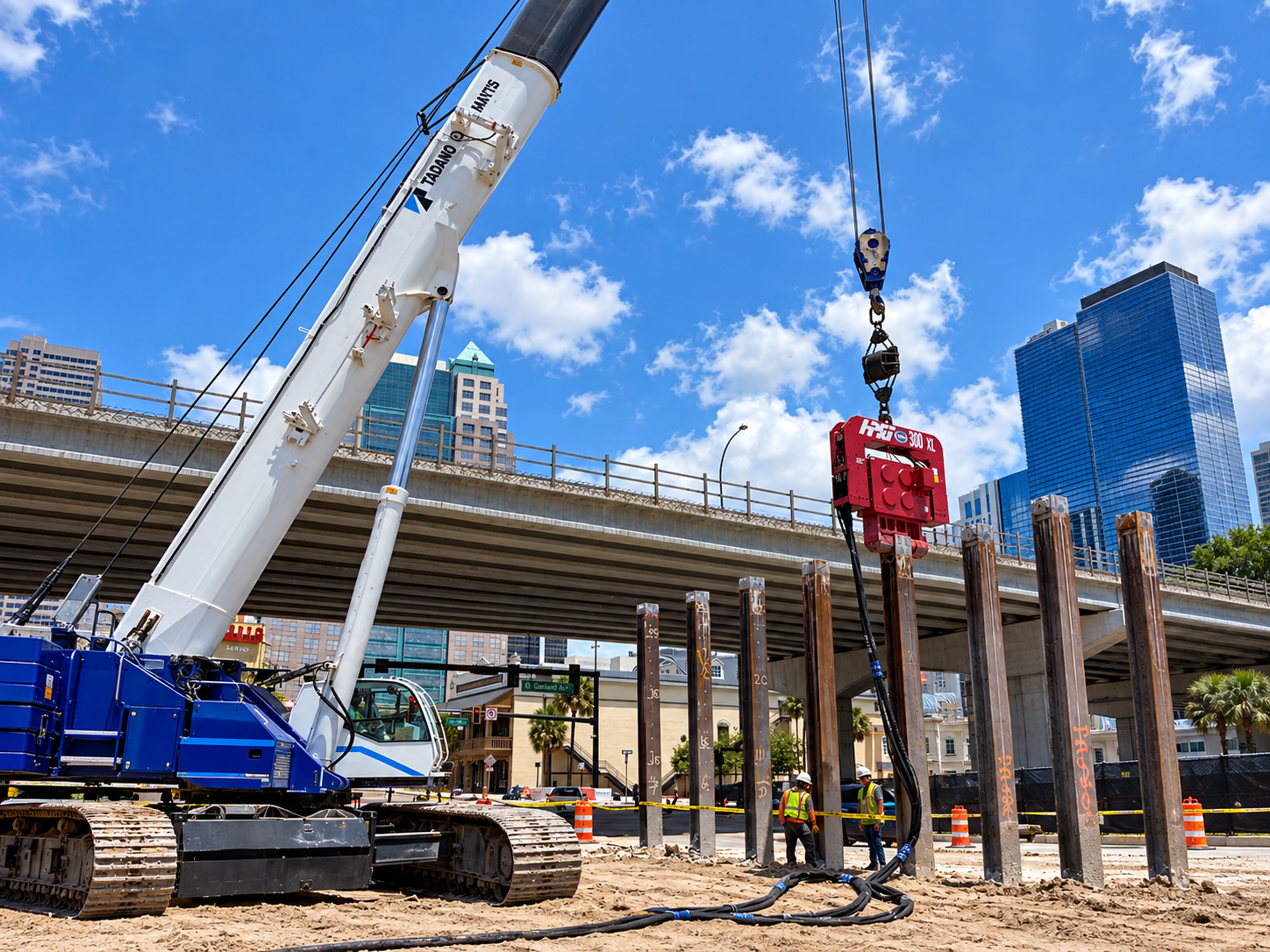
Driven piles arrive at the installation location as structural elements rather than being formed entirely below ground. Depending on the project, they may be steel H-piles, steel pipe piles, precast or prestressed concrete piles, timber piles, or another engineered pile type.
Installation typically uses impact hammers, vibratory equipment, or other approved driving systems. As the pile penetrates, it interacts with the surrounding soil and develops resistance along the shaft, at the pile toe, or through a combination of both.
An important practical characteristic is that the pile exists before it enters the ground. Its dimensions and visible condition can be checked beforehand. During installation, penetration behavior can also be recorded, providing direct information about how the pile responds to the soil profile.
Drilled Shafts Are Built in the Ground
A drilled shaft takes the opposite construction approach. Soil or rock is excavated first, after which reinforcement and concrete are placed to form the structural foundation.
The excavation may remain open without support in favorable conditions, but difficult soils and groundwater can require casing, drilling slurry, or both. When concrete must be placed below slurry or water, tremie placement is commonly used so concrete is introduced from the bottom upward.
The completed shaft can have a much larger diameter than a conventional driven pile. This makes it possible to concentrate substantial foundation resistance into a relatively small number of elements.
Driven Piles vs. Drilled Shafts at a Glance
The major differences become clearer when the systems are compared according to what actually happens in the field.
|
Comparison |
Driven Piles |
Drilled Shafts |
|---|---|---|
|
Construction Principle |
Preformed element installed into soil |
Excavation created and filled with reinforced concrete |
|
Soil Displacement |
Can displace surrounding soil, depending on pile section |
Soil or rock is primarily removed |
|
Ground Vibration |
Impact driving can generate significant vibration |
Typically much lower vibration |
|
Noise |
Impact driving can be loud |
Drilling generally avoids repetitive impact-driving noise |
|
Groundwater |
Does not require an open dry borehole |
May require casing, slurry, or wet construction methods |
|
Element Size |
Usually smaller individual elements |
Large-diameter individual elements are possible |
|
Excavated Spoil |
Little or none from pile penetration itself |
Excavated soil or rock must be handled |
|
Length Adjustment |
Many pile types can be spliced |
Excavation depth can be adjusted before concreting |
|
Preinstallation Inspection |
Pile can be visually inspected before driving |
Final element is constructed below ground |
|
Construction Monitoring |
Driving records and dynamic measurements can be used |
Excavation and concrete placement require close monitoring |
|
Typical Arrangement |
Multiple piles often support a pile cap |
One large shaft may sometimes replace several smaller elements |
|
Main Construction Risk |
Driving difficulty, vibration, damage, refusal |
Borehole stability, groundwater, cleanliness, concrete placement |
Neither column represents a universally superior foundation. The significance of each difference changes with the project.
Installation Creates the Biggest Difference
Driven Pile Installation Is a Continuous Penetration Process
Once pile driving begins, the contractor receives continuous feedback from the pile. Penetration per blow, hammer performance, pile behavior, and changes in driving resistance can all provide information about what is happening underground.
That feedback is valuable when subsurface conditions vary. If a competent bearing layer occurs deeper than anticipated, certain pile types can be spliced and driven farther. Conversely, unexpectedly high resistance can indicate that the pile has reached a dense layer, rock, an obstruction, or another condition requiring evaluation.
The same installation process also creates one of the system’s principal limitations. Driving energy does not remain confined to the pile. Some energy travels through the surrounding ground, producing vibration and, depending on the installation method, considerable noise.
Drilled Shaft Installation Requires Excavation Control
Drilled shaft construction removes the repetitive impact process but introduces a different set of challenges. The contractor has to create an excavation of the required diameter and depth and keep it suitable for reinforcement and concrete placement.
A stable, dry borehole represents the simpler construction condition. Loose soils, caving materials, groundwater, or certain layered deposits make the operation more complicated because the sides of the excavation may not remain stable without assistance.
Temporary casing can provide mechanical support. Drilling slurry can also stabilize an excavation by providing fluid pressure against the borehole walls. Once excavation is complete, the bottom condition, reinforcement placement, and concrete operation become critical because the final structural element is being created below the ground surface.
Soil Conditions Affect the Two Systems Differently
Driven Piles Interact With the Existing Ground
Driving does not require removing the soil occupying the pile location. The pile penetrates through it, and displacement piles push soil outward as they advance.
That interaction can be beneficial from a foundation-resistance perspective, but displacement also deserves attention near existing foundations, buried utilities, retaining systems, and other sensitive facilities. Large groups of displacement piles can influence the surrounding ground differently from relatively low-displacement pile sections.
Dense soil, very hard layers, boulders, debris, or rock can also make penetration difficult. In those situations, pile type, pile-tip details, hammer selection, predrilling, and expected termination depth become important constructability considerations.
Drilled Shafts Exchange Displacement for Excavation
Drilled shafts remove soil rather than forcing most of it aside. That substantially reduces the displacement effects associated with driving, but the removed material now becomes part of the construction operation.
Spoils have to be brought to the surface, handled, stored temporarily if necessary, and ultimately reused or disposed of appropriately. If contaminated ground is encountered, spoil handling can become considerably more complicated.
Soil stability also matters more because there is temporarily an open excavation underground. A material that is straightforward to penetrate with a driven pile may require casing or slurry to maintain a drilled excavation.
Groundwater Can Change the Construction Strategy
Groundwater is one of the most important practical differences between driven piles and drilled shafts.
Driven Piles Avoid the Open-Borehole Problem
A driven pile does not depend on maintaining an empty excavation while it is installed. It can penetrate soil below the groundwater table without first creating a large open hole.
This can simplify construction on sites with high groundwater. Groundwater can still affect geotechnical behavior, corrosion considerations, site operations, and other aspects of foundation design, but it does not create the same borehole-stability and concrete-placement problem encountered with drilled construction.
Drilled Shafts Need a Groundwater Plan
For drilled shafts, groundwater can change the entire installation procedure. Water entering an unsupported excavation can contribute to instability, interfere with bottom cleaning, and make conventional concrete placement unsuitable.
Casing or slurry-supported construction may therefore be required. Concrete placed in a wet excavation also requires carefully controlled procedures, commonly involving a tremie.
The practical conclusion is not that drilled shafts perform poorly in groundwater. They are routinely constructed below groundwater. The distinction is that doing so usually requires more excavation-control measures than driving a pile through the same water-bearing zone.
Noise and Vibration Can Decide the Foundation Type
Driven Piles Transfer Energy Into the Ground
Impact pile driving works by delivering repeated energy to the pile. Ground vibration is therefore an inherent construction consideration rather than an unusual side effect.
How significant that vibration becomes depends on the hammer, pile type, soil conditions, distance from the source, neighboring structures, and other site-specific factors. Noise from impact driving may also affect work near residences, hospitals, offices, schools, occupied buildings, or other sensitive locations.
This does not make driven piles inappropriate for developed areas. It means vibration and noise have to be included in construction planning, and monitoring or mitigation may be necessary where project conditions require it.
Drilled Shafts Reduce Impact-Related Disturbance
Drilling does not rely on repeated hammer impacts, so drilled shafts generally produce much less ground vibration from foundation installation.
That distinction can become decisive on sites where nearby structures or operations are sensitive to vibration. It is one reason drilled foundations may receive serious consideration even when driven piles would otherwise be technically feasible.
Drilling equipment still creates construction noise, and casing installation or other operations may create additional disturbance. The comparison is therefore one of degree, not complete silence versus noise.
Capacity Is More Than a Single Number
Comparisons sometimes reduce the question to whether a drilled shaft can carry more load than a driven pile. That is not particularly useful without considering element size and foundation layout.
Driven Piles Commonly Work as Groups
Individual driven piles are relatively slender deep foundation elements. When structural loads exceed the resistance assigned to a single pile, several piles can be installed and connected through a pile cap.
This modular approach has practical advantages. The same pile section and installation procedure can be repeated across a foundation, making driven piling particularly suitable for projects containing many foundation elements.
The total behavior of the pile group still requires engineering evaluation. Pile spacing, group effects, settlement, lateral behavior, pile-cap design, and the surrounding ground all influence performance.
Drilled Shafts Concentrate Resistance
A drilled shaft can be constructed with a substantially larger diameter, providing a large shaft surface area, base area, and structural section.
That can allow one shaft to resist loads that might otherwise require several smaller piles. The benefit is not simply greater capacity per element. Reducing the number of elements can change the size and complexity of the foundation cap, reinforcement arrangement, layout, and construction sequence.
This is especially relevant where large axial loads, lateral forces, or overturning moments have to be resisted.
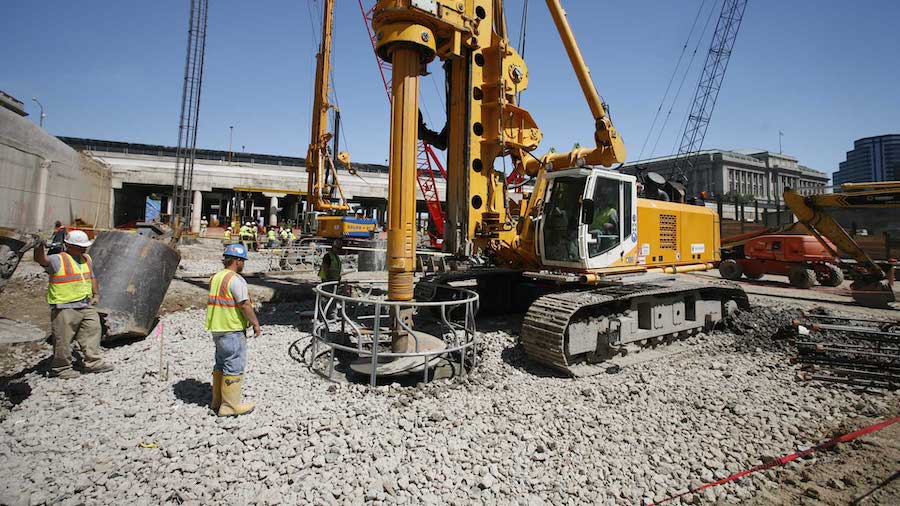
One drilled shaft can sometimes perform a structural role that would otherwise require a group of smaller driven piles. That does not automatically make either system cheaper because foundation cost depends on the complete layout, construction method, ground conditions, equipment, quantities, and testing requirements.
Lateral Loads Can Influence Foundation Selection
Vertical capacity is only part of deep foundation design. Bridges, marine structures, towers, industrial structures, retaining systems, and other foundations may experience significant lateral loading.
Large-diameter drilled shafts can provide substantial flexural stiffness and lateral resistance. Their size can make them attractive where large lateral loads and moments are concentrated at individual foundation locations.
Driven piles also resist lateral loading and can be arranged in groups to meet structural requirements. The appropriate solution depends on pile stiffness, shaft size, soil response, group configuration, structural loading, and allowable movement.
The useful comparison is therefore not that one system handles lateral load and the other does not. Both can. Their geometry and structural arrangement simply provide different ways of developing the required resistance.
Quality Control Works Differently
Driven Piles Provide Installation Feedback
Driven piles have a useful quality-control characteristic: installation itself produces measurable information.
The contractor can document pile penetration and driving behavior throughout installation. Dynamic testing can add measurements of pile response during driving, while static load testing can be used when direct load-displacement verification is required.
The pile can also be inspected before installation. However, driving introduces its own quality concerns, including excessive stresses or physical damage if the pile-driving system and installation procedure are unsuitable.
Drilled Shafts Depend Heavily on Construction Execution
A drilled shaft is manufactured in its final location, largely out of sight. That places greater emphasis on controlling each stage of construction.
Excavation dimensions, borehole stability, bottom cleanliness, slurry condition where used, reinforcing cage position, concrete properties, concrete volume, tremie procedures, and casing removal may all form part of the quality-control process.
Integrity testing can provide additional information about the completed shaft, but good testing does not replace good construction. Preventing defects during excavation and concrete placement remains the primary objective.
Obstructions Create Different Problems
Neither system is immune to difficult subsurface obstructions.
A driven pile may encounter boulders, old foundations, buried debris, very dense layers, or shallow rock that prevents further penetration or risks pile damage. Depending on the project, the response may involve predrilling, changing installation procedures, relocating the pile, or evaluating whether acceptable termination has already been achieved.
Drilled construction can provide more direct options for cutting or drilling through some hard materials, particularly when suitable rock tools are available. However, difficult rock excavation can be slow and expensive, and certain obstructions can also make drilling difficult.
The better foundation system therefore depends on what the obstruction actually is, how deep it occurs, and whether penetration, removal, or socketing is required.
Site Access and Equipment Matter
Foundation designs eventually have to fit on a real construction site.
Driven Piling Needs Handling and Driving Space
Pile-driving equipment requires a suitable working platform and adequate clearance. Long piles also have to be transported, lifted, positioned, and supported during installation.
Splicing can reduce the length that has to be handled at one time, but restricted headroom can still complicate operations. Bridges, overhead utilities, existing structures, and indoor work can all affect equipment selection.
Drilled Shafts Need Space for More Than the Drill
A drilling rig may eliminate the need to handle a full-length pile, but the surrounding operation can still require significant working space.
Excavated material has to be managed. Reinforcing cages must be fabricated or delivered and lifted into position. Casing, slurry equipment, cranes, concrete trucks, pumps, and tremie equipment may also need access depending on the construction method.
As a result, describing drilled shafts as automatically better for confined sites can be misleading. Actual equipment and logistics should be compared before the foundation type is selected.
Driven Piles vs. Drilled Shafts Cost
There is no dependable universal price difference between driven piles and drilled shafts. A meaningful cost comparison must consider the entire installed foundation.
Driven Pile Cost Drivers
Driven pile costs are influenced by pile material, section size, length, quantity, transportation, hammer and crane mobilization, splicing, cutoffs, driving difficulty, testing, and production rate.
Quantity can have a particularly strong effect. Once equipment is mobilized and an efficient driving cycle is established, installing many similar piles can make good use of repetitive production.
Unexpected hard driving, pile damage, obstructions, unusually deep bearing layers, or extensive splicing can reduce that advantage.
Drilled Shaft Cost Drivers
Drilled shaft costs depend on diameter, depth, reinforcement, concrete quantity, drilling rate, soil and rock conditions, groundwater, casing, slurry, spoil handling, testing, and equipment requirements.
A large shaft naturally contains more concrete and reinforcement than a small pile, so comparing the price of one shaft directly with one pile can produce a meaningless result.
The correct comparison is foundation system against foundation system. If one large shaft replaces several driven piles and simplifies the cap, those changes need to be included. If drilling requires difficult rock excavation, extensive casing, or slow wet-method construction, those costs also belong in the comparison.
Construction Speed Depends on Repetition and Ground Conditions
Driven piles can achieve high production rates when many similar piles are installed under favorable conditions. There is no borehole to excavate and no concrete curing period required to create the pile itself because the structural element already exists.
Drilled shaft production involves more individual operations. Excavation, cleaning, reinforcement placement, and concrete placement all occur at the foundation location. Difficult groundwater or rock can extend the cycle further.
However, counting only the installation time per element misses an important point. A project requiring many driven piles may be compared with a design requiring far fewer drilled shafts. Overall schedule should therefore be evaluated at the foundation or structure level rather than by comparing the installation time of one pile with one shaft.
When Driven Piles Make Practical Sense
Driven piles deserve strong consideration where the project benefits from repeatable installation of multiple deep foundation elements, where groundwater would complicate open-hole construction, or where preformed pile elements fit the structural and geotechnical requirements.
They can also provide valuable installation feedback and allow length adjustment through splicing for many pile types. Projects with suitable access and few vibration-sensitive neighbors can take advantage of efficient pile-driving operations.
The tradeoff is accepting the construction effects that come with driving. Noise, vibration, soil displacement, drivability, headroom, and potential obstructions need to be addressed rather than treated as secondary issues.
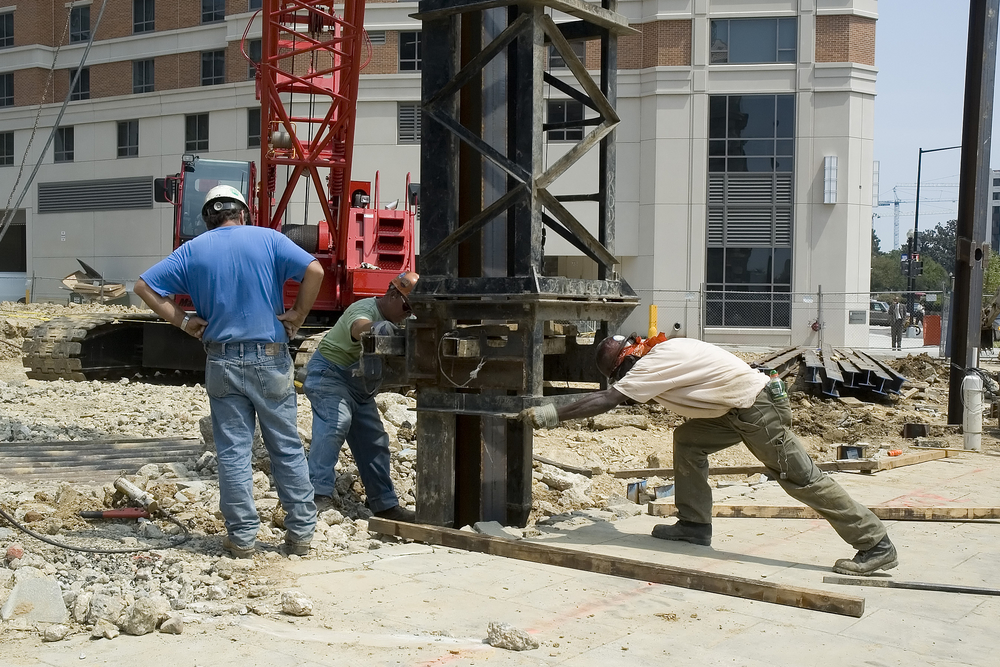
Driven pile installation can provide continuous information through penetration and driving behavior. Drilled shafts shift quality control toward excavation stability, borehole condition, reinforcement placement, and concrete placement because the structural element is created underground.
When Drilled Shafts Make Practical Sense
Drilled shafts become particularly attractive when a project needs large individual foundation elements or when reducing vibration is a major construction priority.
They can concentrate large foundation loads into fewer elements and can provide substantial stiffness for foundations subjected to significant lateral forces and moments. Drilling also avoids the repetitive impact energy associated with pile driving.
The tradeoff shifts toward excavation control. Groundwater, unstable soils, spoil handling, reinforcement installation, concrete placement, and below-ground quality assurance become major construction considerations.
How to Choose Between Driven Piles and Drilled Shafts
The selection should begin with the geotechnical profile and structural loads, but it should not end there. Two foundation alternatives may both satisfy calculated capacity requirements while creating very different construction risks.
The comparison should consider what the contractor will encounter from the ground surface to the foundation tip. Soil variability, rock, groundwater, obstructions, adjacent structures, utilities, access, headroom, environmental restrictions, vibration limits, equipment availability, testing requirements, and construction quantities can all influence the outcome.
This is why foundation selection is rarely solved by a statement such as “drilled shafts have higher capacity” or “driven piles cost less.” Those statements ignore the system around the element.
A more useful question is which foundation system develops the required resistance with manageable construction risk and an efficient overall foundation layout under the actual site conditions.
Final Comparison
The central difference between driven piles and drilled shafts is not simply that one is driven and the other is drilled. It is how those two construction processes distribute risk.
With driven piles, much of the uncertainty becomes visible during penetration. The contractor has to manage driving resistance, hammer energy, pile stresses, vibration, noise, displacement, and possible refusal. At the same time, the foundation element already exists before installation, groundwater does not require maintaining an open borehole, and repetitive pile installation can be highly productive.
With drilled shafts, impact-related vibration and displacement are greatly reduced, and large individual foundation elements become practical. The construction challenge instead moves inside the excavation, where stability, groundwater, cleanliness, reinforcement, concrete placement, and inspection become critical.
That distinction is the most useful way to approach a driven piles vs. drilled shafts comparison. Both are proven deep foundation systems. Neither is universally more capable, more economical, or easier to construct.
For a project with numerous repetitive foundation locations, manageable vibration conditions, and subsurface conditions suitable for driving, driven piles may offer an efficient construction approach. For a project requiring large individual elements, substantial lateral stiffness, fewer foundation units, or reduced installation vibration, drilled shafts may provide a more practical configuration.
The final choice should come from the complete picture: geotechnical conditions, structural demands, construction effects, equipment access, groundwater, quality-control requirements, schedule, and total installed foundation cost. Comparing those factors together provides a much more reliable basis for foundation selection than comparing pile and shaft capacity alone.